
How Restaurants Can Reduce Tableware Waste Without Increasing Operating Costs

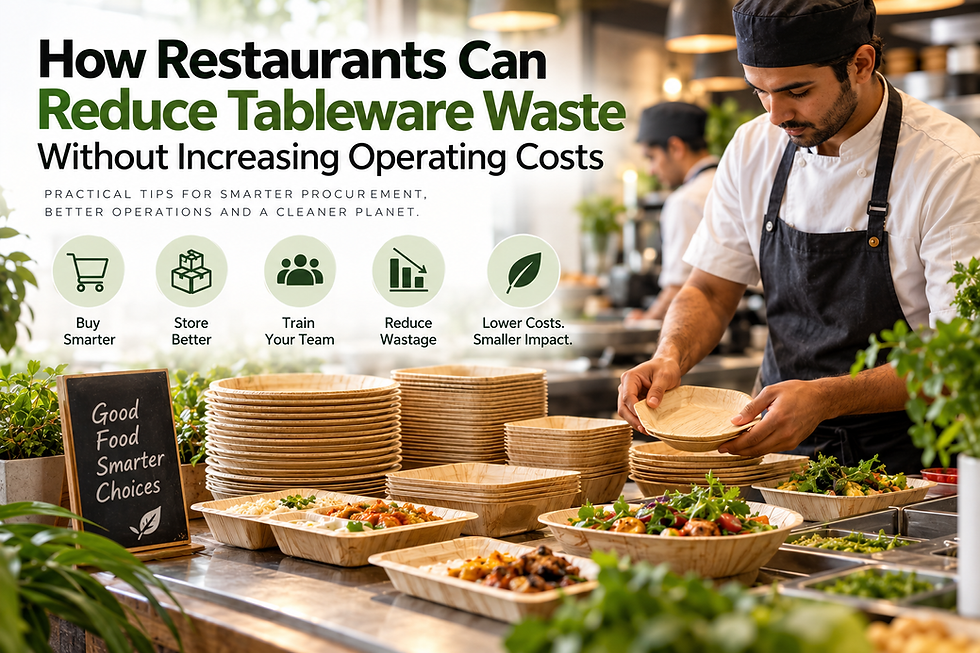
For restaurants, cafés, cloud kitchens, caterers and food-service businesses, disposable tableware is a regular operating expense.
Plates, bowls, trays, takeaway containers and other serving products may be purchased by the thousands every month. Even a small amount of unnecessary usage or wastage can add up over time.
The obvious solution may seem to be switching to cheaper products.
But reducing tableware waste is not necessarily about buying cheaper products.
It is about using the right products, in the right quantities, for the right applications — while reducing unnecessary consumption, damage and over-ordering.
A restaurant can potentially reduce its tableware-related costs by improving procurement, storage, staff practices, portion planning and waste tracking without compromising the customer experience.
So, how can restaurants reduce disposable tableware waste without increasing operating costs?
Let's look at a practical approach.
What Counts as Tableware Waste?
Tableware waste is more than plates that have already been used by customers.
A restaurant can lose money through:
Damaged products
Incorrect orders
Overstocking
Poor storage
Unnecessary double usage
Wrong product selection
Excessive portion-related packaging
Transportation damage
Products becoming unusable before service
Customers taking more products than necessary
This means the first step isn't changing suppliers.
The first step is understanding where the waste is coming from.
1. Start With a Tableware Waste Audit
Before making changes, measure your current usage.
For one month, track:
Number of plates purchased
Number of bowls purchased
Number of takeaway containers purchased
Number of products damaged
Number of products discarded unused
Number of products used per customer
Emergency purchases
Monthly tableware spend
You don't need a complicated software system.
A simple spreadsheet can provide enough information to identify patterns.
Example
Imagine a restaurant purchases 20,000 disposable plates every month.
At the end of the month:
18,500 were used
700 were damaged
300 were discarded because of poor storage
500 remained in stock
That immediately tells the procurement team that the restaurant isn't simply consuming 20,000 plates.
There are multiple factors affecting the number.
2. Calculate Tableware Usage Per Customer
One of the most useful metrics is:
Tableware usage per customer = Total tableware used ÷ Number of customers served
For example:
If a restaurant serves 10,000 customers and uses 12,000 plates:
12,000 ÷ 10,000 = 1.2 plates per customer
That number provides a useful baseline.
If the figure suddenly increases to 1.5, management can investigate why.
Possible reasons could include:
More than one plate being used per customer
Customers taking replacement plates
Changes in menu
Buffet service
Incorrect portioning
Staff practices
Breakage
The objective isn't to force the number down regardless of circumstances.
It's to understand what is driving consumption.
3. Match the Plate to the Meal
One common source of waste is using the same oversized product for every food application.
A small snack doesn't necessarily need a large dinner plate.
A dessert doesn't necessarily need the same plate used for a full meal.
A restaurant can consider creating a basic tableware matrix.
Food Application | Suitable Product |
Snacks | Small plate |
Desserts | Small plate / bowl |
Main meals | Dinner plate |
Curries | Bowl |
Multi-component meals | Compartment plate |
Shared food | Tray / platter |
Matching the product to the food can help reduce unnecessary material use and improve the customer experience.
4. Standardise Your Core Tableware Range
Restaurants sometimes accumulate too many different tableware SKUs.
For example:
6-inch plate
7-inch plate
8-inch plate
9-inch plate
10-inch plate
11-inch plate
If every product has a different use case, procurement and inventory management can become unnecessarily complicated.
Instead, identify your core requirements.
For example:
Small plate + main plate + bowl + compartment plate + serving tray
The exact range depends on the menu.
Standardisation can make it easier to:
Forecast demand
Negotiate pricing
Train staff
Manage storage
Track usage
Reorder efficiently
5. Stop Over-Ordering
Buying more doesn't automatically mean buying smarter.
Bulk purchasing can sometimes reduce the unit price, but excess inventory creates other problems.
Too much stock can:
Occupy storage space
Become damaged
Get forgotten
Tie up working capital
Make inventory harder to track
A better approach is to establish:
Minimum stock level + average usage + supplier lead time + safety stock
For example, if a restaurant uses 10,000 plates per month and its supplier requires two weeks to deliver, the procurement team can maintain an appropriate safety buffer rather than simply ordering as much as possible.
6. Improve Storage
Poor storage can turn usable tableware into waste.
Products should be protected from:
Moisture
Dust
Crushing
Excessive handling
Direct exposure
Poor stacking
Keep cartons in a clean, dry and organised area.
Use older stock before newer stock where appropriate.
A simple FIFO — First In, First Out — system can help prevent older inventory from sitting unused.
This is especially useful when businesses purchase several different tableware formats.
7. Reduce Handling Damage
Every additional movement creates another opportunity for damage.
Consider the journey:
Supplier → Warehouse → Kitchen → Service Area → Customer
If employees repeatedly move cartons between locations, products can be dropped, crushed or mishandled.
Instead:
Keep frequently used products closer to the service area
Use designated storage locations
Train staff on carton handling
Avoid overstacking
Keep reserve stock protected
Small operational improvements can reduce unnecessary product loss.
8. Train Staff on Tableware Usage
Employees play an important role in controlling disposable-product waste.
Staff should understand:
Which plate to use
Which bowl to use
When a replacement is actually necessary
How to handle unused products
Where products should be stored
How much stock should be placed at service stations
For example, if staff routinely place stacks of 50 plates at a buffet station when only 20 are normally required, the remaining plates may be exposed to unnecessary handling and contamination.
A smaller replenishment cycle can reduce this risk.
9. Avoid “Just in Case” Usage
Restaurants often provide extra disposable products because it feels convenient.
Examples include:
Two plates for one customer
Multiple bowls when one is enough
Extra takeaway containers
Excess cutlery
Additional napkins
This can happen because the marginal cost of one item appears insignificant.
But at scale, small quantities become meaningful.
If 100 customers receive one unnecessary disposable item each day:
100 × 30 days = 3,000 additional items per month.
That is 36,000 items per year.
The goal isn't to inconvenience customers.
It is to avoid unnecessary automatic distribution.
10. Let Customers Request Extras Where Appropriate
For takeaway and delivery orders, restaurants can consider changing from automatic inclusion to request-based distribution for selected items.
For example:
Instead of automatically including extra:
Cutlery
Napkins
Spoons
Straws
Condiment containers
customers can be given an option where the ordering system allows it.
This can reduce unnecessary usage without changing the core food experience.
The exact approach should depend on the restaurant's customer base and service model.
11. Review Takeaway Packaging Separately
Dine-in and takeaway waste should not be treated as the same problem.
Takeaway orders may involve:
Main containers
Side containers
Lids
Cutlery
Bags
Sauce containers
Paper wrapping
Additional protective packaging
Review every component.
Ask:
Does this item serve a clear purpose?
If a container is required for food safety and transport, keep it.
If an additional layer exists only because it has always been used, test whether it can be removed.
12. Choose the Right Size of Takeaway Container
Oversized packaging can create unnecessary material use.
A small portion doesn't necessarily need a large container.
At the same time, undersized packaging can cause:
Spillage
Crushing
Poor presentation
Customer complaints
The goal is not simply to use the smallest container.
It is to use the right-sized container for the food and portion.
Create standard packaging combinations for your most popular menu items.
13. Track Damage Separately From Consumption
Used tableware isn't the same as wasted tableware.
Separate your reporting into:
Used
Product was used for its intended purpose.
Damaged
Product became unusable before serving.
Excess
Product was ordered or supplied but wasn't required.
Incorrect
Wrong product, size or specification.
Expired/Unusable stock
Product became unsuitable because of storage or other conditions.
This gives management a much clearer picture of where improvements can be made.
14. Create a Monthly Waste Dashboard
A simple dashboard can include:
Metric | Current Month | Previous Month |
Customers served | 10,000 | 9,500 |
Plates used | 11,500 | 11,400 |
Bowls used | 6,200 | 6,000 |
Damaged pieces | 250 | 320 |
Unused/discarded | 120 | 180 |
Tableware spend | ₹45,000 | ₹44,500 |
Usage per customer | 1.15 | 1.20 |
This allows the business to monitor trends rather than relying on assumptions.
15. Don't Sacrifice Product Quality to Reduce Waste
Reducing waste doesn't mean choosing the cheapest disposable product.
A low-quality product may create more waste if it:
Breaks easily
Bends excessively
Leaks
Arrives damaged
Has inconsistent dimensions
Cannot handle the food being served
In that situation, a cheaper unit price may not translate into lower operating costs.
Instead, compare:
Cost per usable product
rather than simply:
Cost per purchased product
16. Test Products Before Ordering in Bulk
If you're considering a new tableware supplier, order samples first.
Test them with your actual menu.
For plates, test:
Rice
Curries
Sauces
Fried food
Heavy meals
Desserts
For bowls, test:
Soups
Gravies
Curries
Desserts
Evaluate:
Strength
Shape retention
Food performance
Handling
Appearance
Stacking
Storage
This reduces the risk of committing to a large order that doesn't work operationally.
17. Consider Natural Tableware for the Right Applications
For businesses looking to reduce dependence on conventional plastic disposable products, natural tableware can be considered as part of the solution.
Areca palm leaf tableware is one such option.
Envome states that its areca palm leaf products are made from naturally fallen dried palm leaves and are designed as alternatives to plastic/polymer-based plates. The company's product range includes plates, bowls, compartment plates, trays and platters.
Envome also states that its products are home compostable, chemical-free, lightweight and suitable for hard and liquid foods.
However, the correct approach is to select products based on the actual food-service application rather than assuming that one material works for every requirement.
18. Use Compartment Plates Where They Make Operational Sense
Compartment plates can be useful for meals containing multiple food components.
Instead of using:
One large plate
Several separate bowls
Additional serving products
a compartment format may consolidate several meal components into one product.
Envome offers 3-compartment and 4-compartment areca palm leaf plate formats.
Whether this reduces total usage depends on the restaurant's menu and service model, so test the format before standardising it.
19. Reduce Waste Without Reducing the Customer Experience
Cost reduction shouldn't come at the expense of customers.
The objective isn't:
“Give customers fewer products.”
The objective is:
“Give customers exactly what they need.”
For example:
Instead of automatically giving every takeaway customer extra cutlery, provide the appropriate amount and allow customers to request additional items.
Instead of placing multiple plate sizes at a buffet, use the appropriate size for each food station.
Instead of keeping excessive stock at service points, replenish based on actual demand.
These changes can reduce waste while maintaining convenience.
20. Work With Your Supplier
Waste reduction shouldn't stop at the restaurant.
Talk to your supplier about:
Packaging quantities
Carton sizes
Product consistency
Delivery schedules
Damaged goods
MOQ
Lead times
Custom requirements
Repeat-order planning
A supplier that understands your monthly consumption can potentially help you plan inventory more efficiently.
For larger food-service operations, supplier communication becomes particularly important.
21. Build a Simple Tableware Procurement Formula
A practical purchasing formula can be:
Expected usage + safety stock − usable inventory = purchase requirement
For example:
Expected monthly usage: 15,000 pieces
Safety stock: 2,000 pieces
Current usable inventory: 5,000 pieces
Required purchase:
15,000 + 2,000 − 5,000 = 12,000 pieces
This is a simplified example.
Actual procurement should also consider lead time, seasonal demand and event schedules.
22. Identify Your Biggest Waste Source First
Don't try to optimise everything simultaneously.
Rank your tableware waste.
For example:
Waste Source | Estimated Monthly Cost |
Damaged plates | ₹3,000 |
Excess takeaway containers | ₹4,500 |
Unused stock | ₹2,000 |
Extra cutlery | ₹1,500 |
Incorrect orders | ₹1,000 |
In this example, takeaway containers are the first area worth investigating because they represent the largest identified cost.
This creates a more practical improvement process.
23. A 30-Day Tableware Waste Reduction Plan
Restaurants can implement a basic program over four weeks.
Week 1: Measure
Track:
Purchases
Usage
Damage
Excess
Waste
Customers served
Week 2: Identify
Find the top three sources of unnecessary consumption.
Week 3: Test
Try operational changes such as:
Different product sizes
Better storage
Request-based extras
Revised service quantities
Alternative products
Week 4: Review
Compare:
Usage per customer
Waste
Product cost
Customer feedback
Staff feedback
Then standardise the changes that work.
24. A Restaurant Tableware Waste Checklist
Procurement
Monthly usage measured
Supplier lead time recorded
Minimum stock level established
Safety stock established
Products compared on usable cost
Storage
Dry storage available
Products protected
FIFO process implemented
Storage locations labelled
Excess stock identified
Operations
Staff trained
Product usage guidelines created
Extra products distributed only when needed
Service stations monitored
Damage recorded
Takeaway
Container sizes reviewed
Packaging matched to portions
Extra cutlery reviewed
Unnecessary packaging identified
Delivery packaging tested
Measurement
Monthly waste tracked
Usage per customer calculated
Damaged products tracked
Tableware spend monitored
Supplier performance reviewed
The Goal Isn't Zero Disposable Tableware
For many food businesses, eliminating disposable tableware completely may not be practical.
Restaurants may need disposable products for:
Takeaway
Delivery
Catering
Events
Outdoor service
Large-scale feeding
Temporary food-service operations
The more realistic objective is to use disposable tableware intentionally and efficiently.
That means choosing the right product, ordering the right quantity, storing it properly and avoiding unnecessary usage.
Final Takeaway
Reducing tableware waste doesn't necessarily require a major increase in operating costs.
In many cases, the first opportunities are operational:
Measure usage → reduce unnecessary consumption → improve storage → standardise products → control inventory → test suppliers → track results.
Restaurants should also look beyond unit price.
A product that costs slightly more per piece may create better value if it performs consistently and reduces damage, leakage or replacement requirements.
For businesses exploring alternatives to conventional plastic tableware, Envome offers a range of areca palm leaf plates, bowls, trays, platters and compartment formats. The company states that its products are made from naturally fallen areca palm sheaths and are home compostable and chemical-free.
The right solution will depend on the restaurant's menu, service model, budget, storage capacity and waste-management system.
The objective isn't simply to buy less.
It's to waste less while continuing to deliver the same quality of service to every customer.
Frequently Asked Questions
How can restaurants reduce disposable tableware waste?
Start by measuring usage per customer, identifying damaged and unused products, improving storage, standardising tableware sizes, controlling inventory and reducing unnecessary distribution of extra items.
Does cheaper disposable tableware reduce restaurant costs?
Not necessarily. A lower unit price can be offset by breakage, poor food performance, wastage, replacement costs or inconsistent supply. Compare the cost per usable product rather than price alone.
How can restaurants reduce takeaway packaging waste?
Review container sizes, eliminate unnecessary packaging layers, match containers to portion sizes and consider request-based distribution of optional items such as extra cutlery where appropriate.
How do you calculate tableware usage per customer?
Divide the total number of tableware pieces used by the number of customers served during the same period.
Tableware usage per customer = Total pieces used ÷ Customers served
Should restaurants buy disposable tableware in bulk?
Bulk purchasing can make sense when the restaurant has predictable demand, sufficient storage and a reliable supplier. However, over-ordering can create excess inventory and wastage.
Can natural tableware help reduce plastic use?
Natural tableware can be one option for businesses looking to reduce their reliance on conventional plastic disposable products. The appropriate choice depends on food performance, cost, availability and end-of-life infrastructure.
Are areca palm leaf plates suitable for restaurants?
They can be used for a range of food-service applications. Envome offers areca palm leaf plates, bowls, trays and compartment formats and states that its products are suitable for hard and liquid foods.
Are areca palm leaf plates compostable?
Envome states that its areca palm leaf products are home compostable. Businesses should still consider their local waste and composting infrastructure when determining the actual end-of-life pathway.
What is the easiest way to start reducing tableware waste?
Start with a 30-day audit. Track what you purchase, what you use, what gets damaged and what remains unused. Then focus on the largest source of avoidable waste before changing your entire procurement system.


Comments