
Palm Leaf Plates vs Bagasse Plates: Which One Should You Choose?

Palm Leaf Plates vs Bagasse Plates
Palm leaf and bagasse plates are two of the most widely used compostable tableware options on the market today, but they're made from entirely different raw materials and suit slightly different needs. Knowing the difference helps businesses pick the right fit rather than defaulting to whichever option is more familiar.

What Are Palm Leaf Plates?
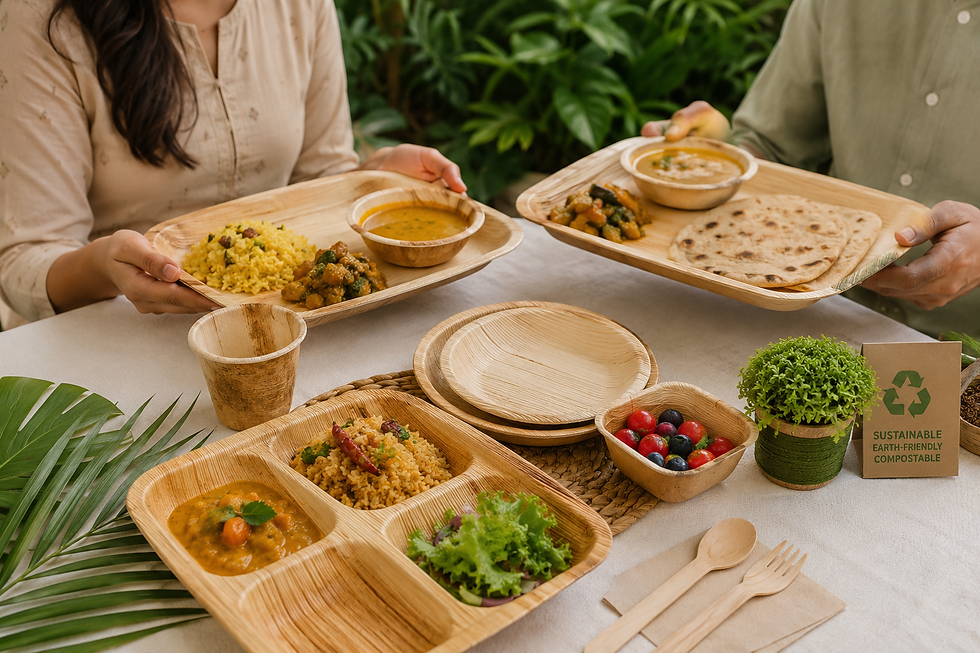
Palm leaf plates are made from naturally fallen palm leaves, cleaned and heat-pressed into shape without chemicals or coatings. Each plate has a distinctive natural grain and a premium, rustic appearance, and no two plates look exactly the same, which many event hosts see as a feature rather than an inconsistency.
What Are Bagasse Plates?
Bagasse plates are made from sugarcane fibre left over after juice extraction, a byproduct that would otherwise often be discarded or burned. They have a smooth, uniform, white or beige appearance and are moulded rather than pressed from a single leaf, giving them a more consistent, factory-finished look.
Key Differences
Appearance: Palm Leaf Plates vs Bagasse Plates - palm leaf plates look natural and rustic; bagasse plates look smooth and uniform.
Best for: palm leaf suits weddings and premium events; bagasse suits everyday takeaway and cloud kitchen packaging.
Heat resistance: both handle hot food well, but bagasse is often preferred for microwave use.
Cost: bagasse plates are typically more economical for high-volume daily use.
Compostability: both are fully compostable with no plastic lining.
Raw material source: palm leaf uses fallen leaves directly; bagasse uses a processed agricultural byproduct.
Environmental Footprint of Palm Leaf Plates vs Bagasse Plates
Both materials are considered low-impact compared to plastic, since they rely on agricultural byproducts rather than virgin raw materials. Palm leaf production involves minimal processing beyond cleaning and pressing, while bagasse requires pulping and moulding, a slightly more involved process that still remains far less resource-intensive than manufacturing plastic or foam.
Which Suits High-Volume Businesses?
For businesses processing hundreds of orders a day, such as cloud kitchens or large catering operations, bagasse plates are often the more practical choice thanks to their lower per-unit cost and consistent, stackable shape that speeds up packing. Palm leaf, with its slightly higher cost and individual character, tends to suit lower-volume, higher-presentation settings.
Combining Both in a Single Business
Some businesses use both materials strategically, choosing palm leaf plates for weddings, banquets, or premium catering, and bagasse for daily takeaway or staff meals. This lets a business match the tableware to the occasion without overspending on premium packaging where it isn't needed.
Making the Right Choice
Businesses often ask which option is more durable for oily or saucy food. Both materials perform well, but palm leaf plates tend to hold slightly heavier or wetter dishes without flexing, making them a strong choice for buffet-style events, while bagasse remains a practical, cost-effective option for daily food service and delivery packaging.
Quick Answer
Palm leaf plates suit premium events like weddings thanks to their natural, rustic finish, while bagasse plates are the more cost-effective choice for high-volume daily use such as cloud kitchens and takeaway packaging. Both are fully compostable with no plastic lining.
Pros and Cons at a Glance
Palm leaf pros: premium natural appearance, strong under oily or wet food.
Palm leaf cons: higher per-unit cost, less suited to microwave reheating.
Bagasse pros: cost-effective at scale, microwave-safe, uniform shape for packaging.
Bagasse cons: less distinctive appearance for premium events.
Key Takeaways
Palm leaf plates are best suited to weddings and premium events.
Bagasse plates are more economical for high-volume daily food service.
Both materials are fully compostable with no plastic lining.
Some businesses use both, matching the material to the occasion.
Explore Envome's Areca & Palm Leaf Plates
To compare textures and finishes directly, browse Envome's areca and palm leaf plates alongside bagasse options for your business.
Why Choose Envome
Envome supplies both palm leaf and bagasse tableware, letting businesses match material to occasion without switching suppliers. Explore Envome's areca and palm leaf plates to see the full range.



Comments